

Germany to spur more investment in LNG terminals
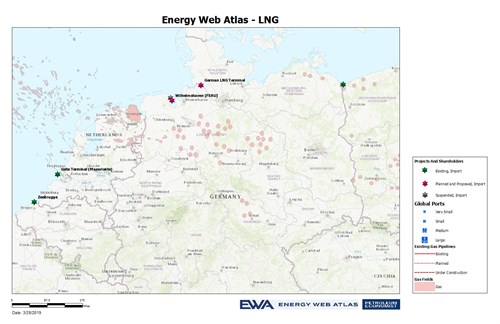
Germany’s cabinet has approved a plan that will make it easier for LNG project companies to invest in new LNG terminals as part of efforts to diversify the country’s sources of gas.
Under the legislation, LNG companies will only pay a 10 percent share of the connection costs for LNG, giving them more scope to invest in LNG projects. At the moment, pipeline companies have to put up the initial cost of the pipelines and then recoup this over the long term via network usage fees that are part of customers gas bills.
 |
| Source: EWA |
“It is important for the supply security of gas in Germany to be able to use as many supply routes and sources as possible,” economy minister Peter Altmaier said in a statement.“We are removing hindrances to private sector investments in the construction of LNG import terminals and we are strengthening competition between different gas imports,” he added.
The government wants to complement gas arriving from Russia, Norway and the Netherlands with other origins to give consumers more choices, while LNG suppliers like Qatar and the United States are seeking more business.
There are three LNG projects seeking applications for permits, including one at Brunsbuettel, supported by RWE, one at Wilhelmshaven, supported by Uniper, and another at chemical firm Dow’s Stade site.
Germany also expects additional gas import volumes from the Russian Nord Stream 2 pipeline which will be under construction by the end of this year.
The government’s move still has to be approved by the Upper House of Parliament, the Bundesrat, which represents Germany’s states.
Reporting by Vera Eckert, editing by Jane Merriman

- Mitsubishi Heavy Industries Compressor acquires Swiss rotating equipment maintenance company AST Turbo AG
- RWE strengthens partnerships with ADNOC and Masdar to enhance energy security in Germany and Europe
- TotalEnergies and Mozambique announce the full restart of the $20-B Mozambique LNG project
- Cook Inlet LNG advances FSRU project in Alaska (U.S.)
- Qatar’s Ras Laffan LNG hub hit by missile attack, ‘extensive damage’ reported

Comments