

US midwest propane inventories enter winter higher than previous five-year average
November 5, 2018
Midwest propane inventories enter winter higher than previous five-year average
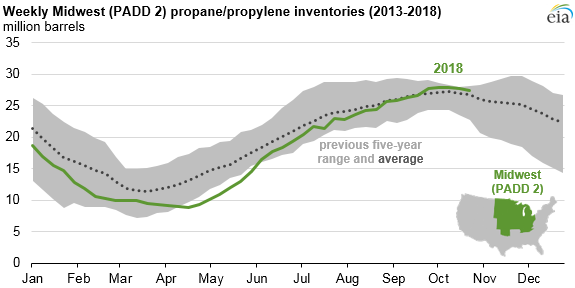
Propane inventories in the Midwest United States had been lower than the previous five-year average for much of 2018, but in recent weeks, net additions to inventories increased Midwest propane to levels higher than the previous five-year average. For the week ending October 19, propane inventories in the Midwest, or Petroleum Administration for Defense District (PADD) 2, were 27.8 million barrels, or 792,000 barrels higher than the previous five-year average.
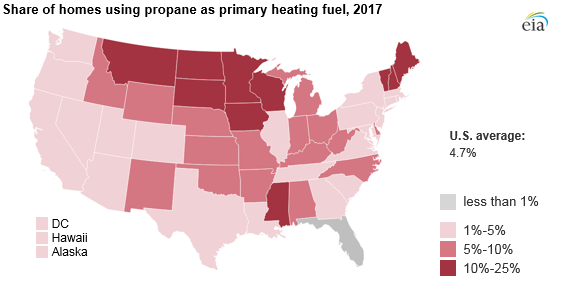
The Midwest accounts for about 21% of propane consumption in the United States and typically holds about 30% of U.S. propane inventories. The Midwest has the highest percentage of homes heated by propane in the United States. In addition to being used for space heating, propane is used as a feedstock for petrochemical plants and for drying agricultural crops before storage.
On Wednesdays during the winter heating season (October through March), EIA releases the Weekly Propane Market Update, which includes sub-PADD breakouts of propane inventories at refineries, terminals, and natural gas plants. These inventory values exclude any propane already in the pipeline distribution network. EIA only tracks propane inventories in the primary supply chain, so propane inventories held at many local storage and distribution terminals are not included in EIA’s data. Inventories of propane in Kansas and Michigan, the two Midwest states with the largest propane inventories, were both slightly higher than the previous five-year average as of October 19.
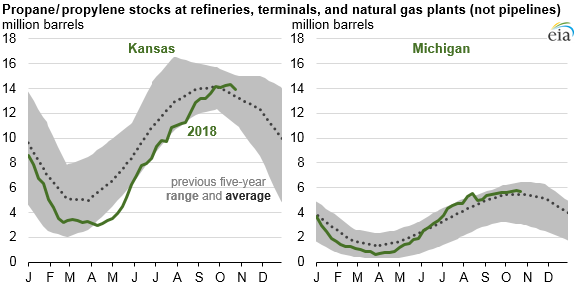
Note: Inventories of propane/propylene may include consumer grade propane, propylene, and any propane and propylene held in mixes.
In EIA’s most recent Winter Fuels Outlook, winter heating expenditures for Midwest households using propane as their primary heating source are expected to decline because, unlike the rest of the country, the Midwest is expected to have warmer weather this winter relative to the 2017–2018 heating season, according to forecasts from the National Oceanic and Atmospheric Administration.
Principal contributors: Mason Hamilton, Owen Comstock

- Mitsubishi Heavy Industries Compressor acquires Swiss rotating equipment maintenance company AST Turbo AG
- RWE strengthens partnerships with ADNOC and Masdar to enhance energy security in Germany and Europe
- TotalEnergies and Mozambique announce the full restart of the $20-B Mozambique LNG project
- Cook Inlet LNG advances FSRU project in Alaska (U.S.)
- Qatar’s Ras Laffan LNG hub hit by missile attack, ‘extensive damage’ reported

Comments