

Stop sour gas flaring: Advances in H2S treatment drive improved economics

FIG. 1. Gas can be recovered, which makes the wasteful and environmentally damaging practice of flaring unnecessary.
Driven by increased global demand for natural gas and liquefied natural gas (LNG), countries across all oil-producing continents are addressing the removal of hydrogen sulfide (H2S) from both gas and oil extraction. This continues to be one of the industry’s longstanding economic and environmental challenges.
Treating H2S adds costs, so operators prioritize sweet formations when all other attributes are equal. However, areas with high concentrations of sour formations—including the Middle East, Kazakhstan, Canada, and the U.S., among other countries—all contain huge reserves worth tapping into.
In the past, exploration and production companies would plug wells or build expensive plants to treat sour gas and crude. Today, most operators rely on far more effective and economical solutions.
Emissions intensity. In 2023, Middle East drill sites were seen flaring across the Gulf from where COP28, the 2023 UN Climate Change Conference, was being held in Dubai. Routine flaring was banned in the United Arab Emirates (UAE) 20 yrs ago, but satellite images show it continues despite the potential impact on inhabitants and those within proximity of the wells. Gases spread hundreds of kilometers across the region.
In 2024, Texas E&P operators disposed of excess natural gas during a time of oversupply and weak prices by flaring. The Railroad Commission of Texas (RRC), the U.S. state's oil and natural gas regulatory body, approved 21 exemption requests from operators in one week alone. Most of the requested and granted permits were for Permian and Eagle Ford shale fields, resulting in more than four times the flaring level approved in 2023.
According to the International Energy Agency (IEA), approximately 140 Bm3 of natural gas is flared globally each year.
The World Bank's Global Gas Flaring Tracker, the only global and independent indicator of routine gas flaring, publishes estimates of global flaring levels and tracks progress for governments, oil and gas companies, civil society, and international organizations to enhance understanding of the global state of gas flaring. The Global Flaring and Methane Reduction Partnership (GFMR), a multi-donor trust fund, is committed to ending routine gas flaring at oil production sites worldwide to reduce methane emissions from the oil and gas sector to near zero by 2030.
The evolution of H2S treatments. Early efforts to treat and remove H2S focused only on the odor, using solutions like soda ash. In 1883, advancements led to the Claus process, which converted the H2S into elemental sulfur, making it a commercially viable byproduct. In 1924, significant developments occurred in Canada's Turner Valley region, where the first plant to chemically scrub H2S from sour natural gas was built, marking a critical step in the industry's understanding of H2S management.
The presence of H2S in upstream operations was recognized as early as the 1940s. The liquid redox process was developed during the late 1950s using vanadium and became the first liquid-phase oxidation process for converting H2S to sulfur to gain widespread commercial acceptance. In the 1980s, iron replaced vanadium in the liquid redox process. Scavengers became widely used in the 1980s in hydrocarbon processing facilities to maintain plant worker safety and productivity, and eliminate odor emissions.
Leveraging technology, science and engineering for upstream emissions. Throughout the decades, approaches for treating H2S have advanced as chemistries and technologies have become more sophisticated. Today, these approaches range from microbiological methods to membrane separation, cryogenic distillation, advanced oxidation processes, and scavengers, among others, giving producers the option of sweetening sour gas and oil at lower costs.
Several regenerative and non-regenerative scavenger methods are available today, all of which are applicable to upstream operations, creating expectations for the H2S scavenger market to be worth more than $800 MM by 2033.
For small amounts of H2S, liquid triazine has been the technology of choice for most operators. Recently, however, operators are moving away from triazine due to carryover and fouling issues. When triazine carries over from the gas treatment into the liquid oil, it can contaminate the oil to a level buyers will not accept or will require the operator to discount the oil. As a result, operators are seeking other chemistries, and some liquid triazine suppliers are now offering triazine alternatives.
Solid scavengers like adsorbents are the historical choice for upstream applications with higher amounts of H2S. Now, solid scavengers are being used in lieu of the triazine applications where operators are running into carryover and fouling issues in the smaller applications, as well.
Originally, solid scavengers were known as iron sponges where wood chips were impregnated with iron oxide to increase the surface area. While the sulfur capacity was good, the use of this particular product declined due to its pyrophoricity. To overcome this problem, wood was later replaced by clay supports. These products were successful in preventing fire incidents while maintaining high sulfur capacity, but they created a new problem: severe media bridging.
From an operational perspective, this bridging or caking phenomena causes a sudden and unmanageable high pressure drop across the bed, expediting gas channeling, which results in shortened bed life. Furthermore—and more importantly, from a safety perspective—the cleaning of bridged media replacement creates a challenge for operators. Hardened material is extremely demanding to remove, often requiring a jackhammer or hydro-blasting to chisel it away. In many cases, operators are exposed to confined spaces as they must enter the vessels to mechanically remove the bridged media to the walls. Bridged media may also contain pockets of H2S, thus creating an additional safety hazard.
In the past 10 yrs, an innovative iron-based solid adsorbenta has been developed, patented and proven to work in numerous upstream, midstream and downstream facilities. This new technology has overcome the issues with the previous products’ pyrophoricity and severe bridging. The proprietary, iron-based solid adsorbenta was designed to completely remove H2S from any gas stream while imparting low and stable pressure drop throughout the entire bed life. The solid adsorbent’sa proprietary composition and manufacturing process ensures free-flowing material at the end of life, making turnarounds easier and safer for operators and maintenance crews.
The purity of this solid adsorbenta allows for a sulfur loading capacity that is 2–3 times higher than conventional products at a lower cost, offering the lowest operational expenditure (OPEX) available in the market. The solid adsorbenta can be used to remove H2S from any gas stream and from light liquid hydrocarbon streams, with an add-on bonus of removing small quantities of light mercaptans and oxygen, further preventing corrosion issues (FIG. 2).
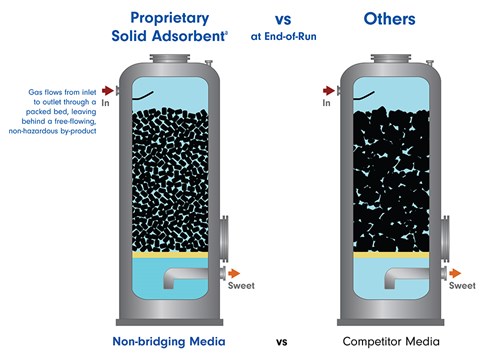
FIG. 2. A vessel at end-of-run (EOR) with the author’s company’s non-caking adsorbenta vs. a competitor with caking.
The author’s company is now supplying the solid adsorbenta media as well as offering skid-mounted equipment packages for sale or lease. Operators can choose from standardized systems with very short lead times to fully customized systems to meet their specific sites specifications for a wide range of operating conditions.
Not all liquid redox is created equal. Larger gas streams with increased H2S content can also be recovered and provide value if they can be treated efficiently in a cost-effective manner. This benefits clients in multiple ways. First, they gain the economics of the recovered gas stream that can then be used as a saleable product instead of having it be sent to flare. That same stream can also be used to power their own operations, which lowers OPEX. Additionally, they become better economic stewards as they help prevent the formation of sulfur dioxide (SO2) and the formation of acid rain and other environmental hazards.
For the even larger gas applications with 1.5 long tpd–20 long tpd of sulfur removed, the author’s company’s iron-based liquid redox technologyb has been deployed, developed and optimized over the past 45 yrs. Liquid redox removes H2S from sour natural gas and other gas streams, converting it to elemental sulfur via an iron catalyst reduction-oxidation reaction in an aqueous solution. As with any technology or solution, not all liquid redox technologies are equal. The author’s company’s liquid redox technologyb was developed in the late 1970s. Early iron-based units deployed in the 1980s had technical issues with sulfur sticking to surfaces. These issues have been reduced significantly with major engineering improvements through the turn of the century and further improvements over the past 25 years in the art and experience of keeping sulfur moving with system internals. This liquid redox technologyb has the proven reliability and ease of operation backed by more than 45 yrs of engineering and operations experience (FIG. 3).
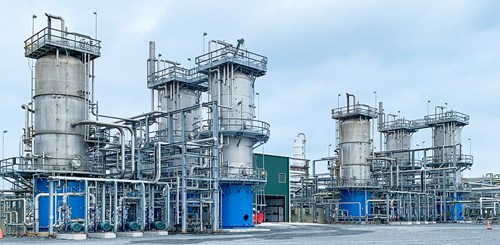
FIG. 3. The liquid redox technologyb converts H2S to solid sulfur at low pressures and temperatures with no liquid effluents or liquid waste streams.
This technologyb uses a chelated iron solution to convert H2S to innocuous, elemental sulfur. It uses no toxic chemicals and produces no hazardous waste byproducts. Its environmentally safe catalyst is continuously regenerated—so operating costs are low—and its aqueous-based ambient temperature process applies to any gas stream. Even with its high removal efficiency, the technology's design has a small carbon footprint. There are no liquid waste streams, so it does not require treatment and disposal, and it is far less expensive than other liquid redox technology alternatives. Its unique design allows for 100% turndown in gas flow and H2S concentrations.
The overall system oxidation reaction is as follows (Eq. 1):

The well-known oxidation reaction is sub-divided into two parts:
- Reduction: H2S gas absorption, ionization and reaction to make solid sulfur in the liquid solution
- Oxidation: The liquid solution is oxidized using air and regenerated for re-use.
For more than 45 yrs, the company’s liquid redox technologyb has been continuously evaluated and refined and has been a favored solution for large upstream, midstream and renewable applications.
The vendor selection process. With the increasing global demand for LNG, operators now have even more incentive to capture gas and stop flaring. In addition to the enhanced economics of selling gas, operators can also help reduce emissions and pollutants that cause acid rain. Selecting a H2S gas removal technology purchase can be onerous as decision-makers analyze what questions to ask potential vendors to determine their best path forward.
The challenge is that not all vendors are created equal. The selection process should take into consideration essential capabilities rather than simply a product purchase. Vendors will often only compare their cost to triazine alone and clients must understand what other offerings are available to them, often at significant cost savings. The selected vendor must have the capacity to become a strategic partner, and factors to consider should include platform maturity, service and support capabilities, company record of accomplishment, as well as specific use cases that call out pounds of sulfur removed and SO2 production avoided annually. In the end, clients should have all the information possible to allow them to make the best decision to solve their H2S treatment problems.
NOTES
a SULFURTRAP®
b LO-CAT®
ABOUT THE AUTHOR
Robert Hawley brings more than 40 yrs of chemical engineering strategy, sales, marketing and engineering design experience to his role as Senior Technology Licensing Director for Merichem Technologies. During his 11 yrs with Merichem, his focus has been on selling and designing sulfur plants. Robert earned a BS degree in chemical engineering from Cornell University and an MBA from Duke University.


Comments