

Loaded Qatar LNG vessels retreat after nearing Strait of Hormuz
Two vessels loaded with liquefied natural gas (LNG) from Ras Laffan, Qatar, turned back after they moved eastward towards the Strait of Hormuz, ship-tracking data showed on Monday.
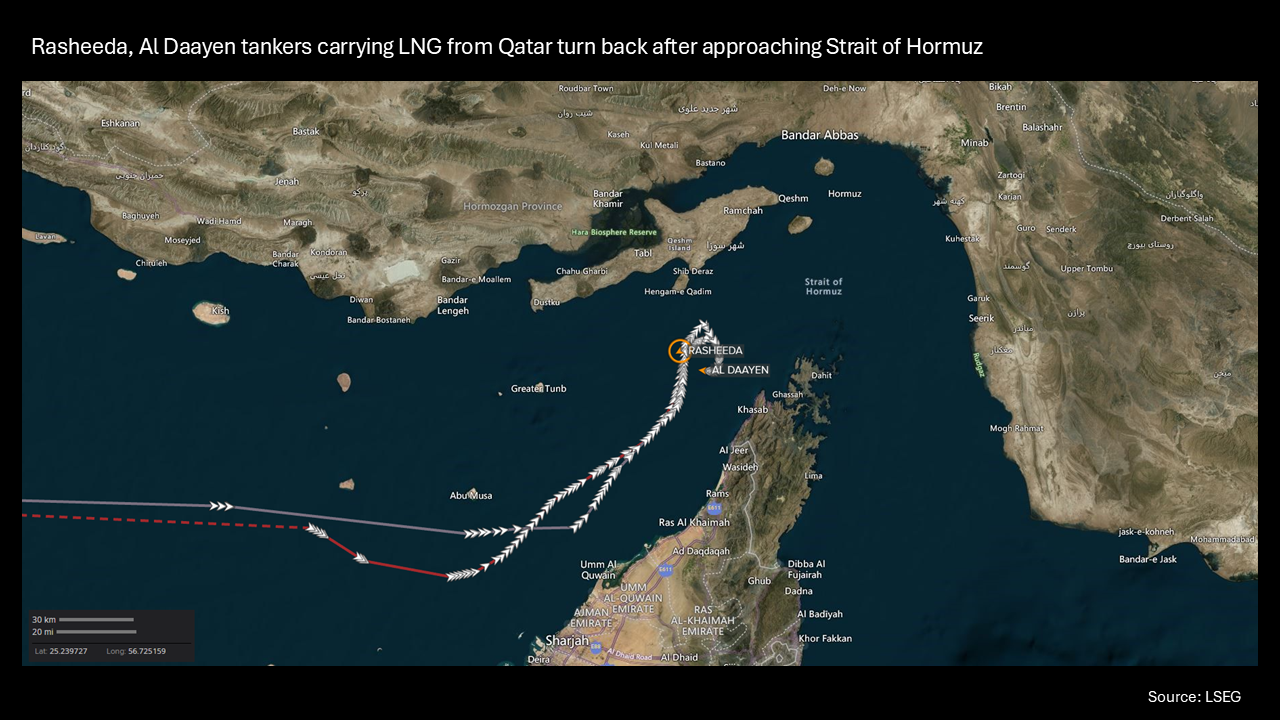
Had the vessels successfully crossed the strait, it would have been the first transit of LNG cargoes through the waterway since the U.S.-Israel war with Iran began on February 28.
Data from analytics firms Kpler and LSEG showed the vessels, Al Daayen and Rasheeda, loaded their cargoes in late February. The data also indicated that the Al Daayen tanker was signaling for China at the moment.
Additionally, Kpler data showed both tankers as controlled by QatarEnergy. QatarEnergy did not immediately respond to a request for comment.
Previously, a Japanese LNG tanker, the Sohar LNG, managed to cross the strait, its joint owner Mitsui O.S.K. Lines said on Friday (LEARN MORE). The tanker, however, was empty, and a company spokesperson declined to disclose when the passage took place or whether any negotiations were involved.
It has been more than five weeks since the U.S. and Israel began striking Iran in a war that has killed thousands and damaged economies by driving up oil prices, with tanker traffic through the Strait of Hormuz choked by the fighting and retaliatory attacks on a route that carries about a fifth of global oil and LNG flows.
Qatar is the world's second-largest exporter of LNG, with shipments mostly going to buyers in Asia. Iranian attacks, however, knocked out 17% of Qatar's LNG export capacity, with repairs expected to sideline 12.8 MMtpy of the fuel for three to five years.
Related News
Related News

- Cheniere signs deal with Bechtel to expand U.S. LNG export capacity
- TC Energy approves $1.5-B Columbia Gas expansion after profit tops estimates
- Wärtsilä continues to expand its data center footprint with new 790 MW order in Texas
- Baker Hughes’ fuel flexible NovaLT™ 16 gas turbine certified by RINA for marine propulsion
- U.S. natural gas exports to grow nearly 30% by 2027 as LNG facilities ramp up

Comments