

China's LNG imports plunge, helping Asia adjust to Iran war losses
Asia's imports of liquefied natural gas (LNG) are poised to drop to the lowest in nearly six years in April as the effective closure of the Strait of Hormuz cuts off cargoes from major supplier Qatar.
Despite the loss of volumes, it could be argued that Asia's LNG markets are being more successful in adjusting to the fallout from the U.S. and Israeli attacks on Iran than those for crude oil and refined products.
This is largely being achieved through a combination of voluntary curtailment of imports by China, the world's biggest buyer of the super-chilled fuel, and forced loss of cargoes in smaller and less wealthy buyers such as Pakistan.
Commodity analysts Kpler estimate Asia's imports of LNG for April at 19.03 million metric tons, down from 20.69 million in March and the winter peak of 26.34 million in December.
April arrivals are the lowest since June 2020 and reflect a sharp loss in volumes from Qatar, which prior to the Iran war supplied around 20% of global LNG.
Asia's imports from Qatar are estimated at just 800,000 tons in April as the last of the cargoes that exited the Strait of Hormuz prior to the U.S. and Israeli strikes on February 28 arrive at their destinations.
The average of Asia's imports from Qatar in the three months leading up to the war against Iran was just over 6 million tons, which was about 88% of Qatar's total volumes.
Such a sharp loss of Qatari cargoes has forced Asian buyers to adjust and much of the heavy lifting has been done by China.
Kpler estimates China's LNG imports at 3.36 million tons in April, the lowest since 3.18 million tons in April 2018 and down from the winter peak of 7.66 million tons in December.
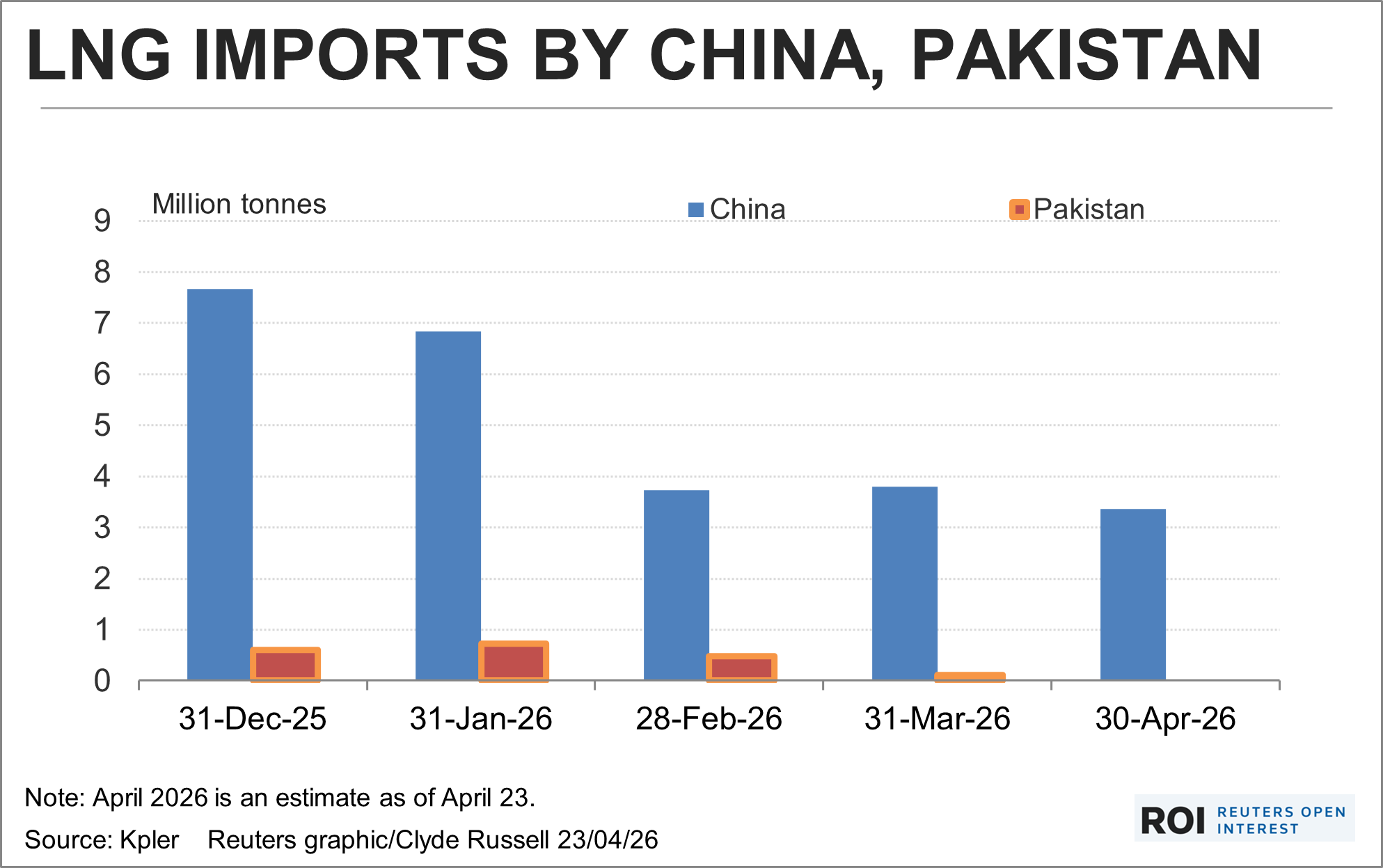
China has also been re-selling cargoes, with LNG exports hitting a record high of 720,000 tons in March, but dropping back to just 30,000 tons in April.
What this shows is that China's LNG buyers have been happy to trim demand amid the higher prices caused by the Iran war, and even take advantage of the spike in March to re-sell cargoes.
Spot Asian LNG LNG-AS jumped from $10.40 per million British thermal units (MMBtu) in the week to February 27 to a high of $25.30 in the seven days to March 20.
The price has since eased to $16.05 per MMBtu in the week to April 17, leaving it 54% higher than pre-war levels.
This compares to a 97% jump in the price of jet fuel in Singapore over the same period and a 59% rise in the price of gasoil, the building block for diesel.
PAKISTAN, BANGLADESH. While China has been able to lower LNG imports and re-sell cargoes because of strong domestic natural gas output and pipeline supplies from Russia and Central Asia, the same is not the case for South Asian countries.
Pakistan's LNG imports may drop to zero in April as the cargoes being monitored by LSEG for arrival this month are still stuck west of the Strait of Hormuz and therefore unlikely to transit the waterway and sail to Pakistan.
Only two LNG cargoes discharged in Pakistan in March, delivering 150,000 tons of LNG, down from 479,000 tons in February and 721,000 tons in January, according to LSEG data.
Pakistan gets nearly all of its LNG from Qatar, with only one cargo from another country arriving in the past year, meaning it is extremely vulnerable to the closure of the Strait of Hormuz.
Another country that was highly reliant on Qatar is Bangladesh, but it has been able to secure cargoes from other suppliers and therefore maintain LNG imports at levels close to pre-war volumes.
Bangladesh is forecast to see arrivals of 531,000 tons in April, down from 561,000 tons in March, and its slate of suppliers includes the United States, Australia, Oman, Nigeria and Angola.
In January and February, Bangladesh only received cargoes from Qatar.
The difference between Pakistan and Bangladesh comes down to a willingness to pay more for spot LNG, with the price surge in the wake of the war against Iran rendering the fuel uneconomic for Pakistan electricity generators.
The views expressed here are those of Clyde Russell, a columnist for Reuters.
Related News
Related News

- Cheniere signs deal with Bechtel to expand U.S. LNG export capacity
- TC Energy approves $1.5-B Columbia Gas expansion after profit tops estimates
- Wärtsilä continues to expand its data center footprint with new 790 MW order in Texas
- Baker Hughes’ fuel flexible NovaLT™ 16 gas turbine certified by RINA for marine propulsion
- U.S. natural gas exports to grow nearly 30% by 2027 as LNG facilities ramp up

Comments